Showing posts with label science fiction. Show all posts

Thursday, October 15, 2015

Sci-fi that's short but (bitter)sweet

The Gaijin Girl: A Mayake Chronicles Short StoryThe Gaijin Girl: A Mayake Chronicles Short Story by E.E. Giorgi
My rating: 4 of 5 stars

A futuristic fairytale that's hard to put down. I won't say much because it's such a quick read and I don't want to spoil anything, but I will say that it takes on themes of theory vs. reality. Literature, social networks, and even people's self-conceptions are veiled in questions about what's real and what's not. Against this backdrop, we watch a girl named Lilun as her lonely, restrictive childhood approaches its end.

Whether or not you've read other books in the Mayake chronicles, this story is an intriguing window into a perspective that's been kept hush-hush in the rest of the series. It's always fascinating to see "villains" in their day-to-day life, and even better when this perspective challenges our preconceptions of what they're like.

View all my reviews

Friday, October 9, 2015

My trouble with martians...

The MartianThe Martian by Andy Weir
My rating: 3 of 5 stars

As a lot of us are aware by now: Mark Watney is the 17th person to set foot on Mars and the first to be stranded on it. After his crew mistakenly leaves him for dead while evacuating during a dust storm, Mark has to figure out how to survive as the only human on the planet - or become the first one to die there.

And there's a lot to figure out: food, water, communication, transport. Much of the book is spent describing how Mark (almost typed "Mars") and NASA attempt to solve these problems - in detail. Andy Weir clearly did a lot of work to come up with plausible solutions. At times the book is reminiscent of the Methods section of a real scientific paper, which is something that people often skip because it's tedious - so it's to Weir's credit that he's written pretty readable descriptions that don't slow down the story. It makes me wonder if science textbooks in the form of adventure stories could someday be a thing. Novel-length word problems.

I liked watching the conflict between scientists and administrators - the hilariousness and frustration of which I'm sure many scientists can relate to. But my absolute favorite parts of the book were the cameos of previous, real-life Mars missions. It brought back the excitement of watching those missions unfold. Space rovers always seem like the most heroic of inanimate objects.

Unfortunately, the emotional connection evoked by spacecraft didn't extend to the human characters, who at best seem like two-dimensional tropes (the Aspergers one, the hot nerd, etc.) and at worst just blur into each other. Mark is somewhat funny, but not that funny, and woodenly impervious to most physical and mental consequences of prolonged isolation and malnutrition. The style of writing is unremarkable, although I guess Weir gets away with it by framing it as the no-frills log of a desperate astronaut. The logs are mixed in with passages of various side characters' POVs, an ominous omniscient narrator, TV transcripts, and the like.

But y'know, different authors try to accomplish different things, and once I accepted that Weir wasn't aiming for beauty or complexity, I was able to sit back and enjoy the slapstick space shenanigans. However, one thing that I couldn't get past was the questionable way that it presents women in science. Even if we put aside some of Mark's comments because they're just part of his oh-so-irreverent personality (umm), the problem remains that the geekiness of the book is only of the smug, socially unaware, male-gaze variety (like The Big Bang Theory on a larger scale).

Commander Lewis is a woman who's capable and respected, and that's awesome. But she's the exception rather than the norm. Let's say you're a woman who wants to work in science but you don't have, or don't want, Lewis's military background. What other possibilities are presented to you in the world of The Martian? You can take on a helper role, like Annie's, where understanding science is secondary to being glamorous. Or you can be knowledgable and quick-thinking like Johanssen, as long as attractiveness is still your main claim to fame. Or you can be like Mindy: You may get credit for being observant and hard-working, but you still face people (mostly men) who judge you by your appearance, who are polite because they worry about your delicate feelings rather than because you deserve respect, and who readily pull rank and demote you as they please. These small details of characterization seem insignificant next to Watney's struggle and NASA's efforts to save him. But with every throwaway gesture that suggests female scientists don't warrant the same respect as their male counterparts, the book quietly works against the ideals of Teamwork and Progress that it outwardly glorifies.

View all my reviews

Friday, September 11, 2015

Love, loyalty, and Turing tests.

Nirvana (Nirvana Series #1)Nirvana by J.R. Stewart
My rating: 2 of 5 stars

2.5 stars, and a trigger warning: the book contains several descriptions of sexual abuse.

The premise of this story is brilliant: when her husband Andrew disappears, Larissa searches for clues about what happened to him, long after the authorities tell her to accept his death. To escape the grief and exhaustion of her everyday life, she retreats into a virtual reality world called Nirvana. In Nirvana, she discovers Andrew's likeness alive and well in a field of apple trees. He wants her to believe that he is real, and Larissa must separate the actual from the virtual: is Andrew truly alive somewhere and trying to communicate with her, or is she being fooled by her own hopes and someone else's clever programming?

The narration uses first and third person as well as present and past tense, although it's not as confusing as it might sound: once you figure out the pattern, you can tell what's happening "now" vs. what happened in the past. The bigger problem with the narration is its omniscience: with every point of view that is added, some of the suspense seeps away. We lose the otherwise ever-present mystery of what other people are thinking. And even though we are shown many characters' perspectives, it's often only a surface-level view that doesn't make them seem more lifelike. My favorite parts of the book were Larissa's anecdotes about her life with Andrew, because those passages show intense emotion and a unique voice. If Larissa had narrated the whole story, it might have been more compelling. Although I wish she'd had some "quirk" other than bibliophilia - like most book-lovers in fiction, it comes across as an attempted shortcut to reader sympathy.

Even though I was curious about this particular dystopia - with people living in secluded "bubbles" and spending so much time in virtual worlds - the explanations didn't really fascinate me because they were presented in a series of vague info-dumps. The overall style of writing seemed a little clunky at first, but I felt that it flowed better as I got further into the novel.

Books are, in way, like virtual reality systems themselves: the reader wants to get immersed in the world, and to believe that the characters they encounter have beating hearts and unique minds. Nirvana did not quite convince me of those things, but I give it credit for a compelling premise that could potentially be developed further into a powerful story.

View all my reviews

Sunday, August 23, 2015

Sometimes interpretation is a trap. Sometimes we need to simply observe.

Falling in Love with HominidsFalling in Love with Hominids by Nalo Hopkinson
My rating: 4 of 5 stars

Nalo Hopkinson covers so much ground in this short story collection that perhaps it's easier to list what she doesn't accomplish in these tales:

1) Reinforce stereotypes of how the protagonist of a fantasy story should look/act/dress.
2) Sugar-coat the fact that painful and unjust things can happen.
3) Make anyone feel powerless over point #2.

In the preface of the book, Hopkinson talks about how these stories grew out of a change in perspective that she'd experienced, from a teen pessimistic about the seemingly incurable injustices that she'd witnessed, to a woman doing her part to help solve these problems. The efforts of herself and others helped her to feel more positive about humanity's prospects, in spite of all the pain that she remained aware of. The business of doing good can be a complicated, difficult thing. Nobody is expected to carry it out perfectly, but nor is anyone exempt from having to try - and this is an idea that the characters here grapple with, each in a unique way.

Hopkinson is a master of dropping clues that at first seem innocuous, but which unmistakably reach a critical mass, at which point the reader just knows that something's up - and it's only a question of how dangerous that something is going to become. And you never know the answer ahead of time, because Hopkinson's imagination is boundless and unencumbered by distinctions between sub-genres. Ghosts? Nature spirits? Time-traveling museum curators? Or post-apocalyptic horrors? Whatever your preference, this book has a story for you. If you enjoy the likes of Neil Gaiman's work - fantasy percolating through reality in mysterious ways, often dark but never fully devoid of light - this book might be up your alley.

To list just a few favorites:

Message in a Bottle. The never-ending question of what each generation will cherish about the past - or alternatively, the question of how far a child will go in trying to manipulate an adult.

The Smile on the Face. A teenage girl, struggling to accept herself, goes to a party where not everyone wishes her well. The consequences are stunning. And can I say how refreshing it is to read about two women of different shapes who learn to appreciate each other as well as themselves? Additionally, I love Hopkinson's ability to create non-human characters.

Emily Breakfast. It gets off to a sweet start, but given the grisly nature of several of the other stories here, I raced through it in a panic, knowing that something horrible might rear its head at any moment.

A Young Candy Daughter. Hopkinson sums it up best: I'm not the only person who's ever asked the question, "What if God was one of us?" But maybe "us" looks a little different from my side of the sandbox.

As with most collections, there are some stories that struck me as rough spots that aren't at the same level as the ones above. But even in these cases, I still admire the ideas behind them.

I loved the little introductions that Hopkinson gives before each piece, which hint at the origins of the story. She seems like the kind of person whose imagination can latch on to any image or word or sound, growing it from a seemingly mundane seed into a spectacularly blossoming vision of what a different reality could be like.

View all my reviews

Sunday, August 16, 2015

The good always die young, even if they live to be a hundred.

The Snow Queen (The Snow Queen Cycle, #1)The Snow Queen by Joan D. Vinge
My rating: 5 of 5 stars

There's more to me, more to the universe, than I suspected. Room for all the dreams I ever had, and all the nightmares... heroes in the gutters and in the mirror; saints in frozen wasteland; fools and liars on the throne of wisdom, and hands reaching out in hunger that will never be filled... Anything becomes possible, after you find the courage to admit that nothing is certain.

The Snow Queen is about change crashing against the bulwarks of stability. It's about a heart freezing over and struggling to thaw. It's about a planet on the cusp of new politics and climates. And it's about an anthropocentric value system buckling under the weight of the universe's unfathomable diversity.

Like its fairy-tale inspiration, the story begins with a girl and a boy, Moon and Sparks, who seem inseparable. But as they reach adulthood, Moon's seemingly oracular gifts pull her in one direction, while Sparks's ambitious curiosity pull him in another - into the distant, technologically advanced land of Winter. There, he meets a woman who, though 150 years old, has a youthful face and a striking resemblance to Moon; her name is Arienrhod, and she is the Winter Queen. Mesmerized, Sparks is drawn deeper and higher into Arienrhod's court as a predatory cynicism subsumes his personality - and he's not going to fight it.

"We all choose our own paths to hell. But some of the choices are easier to watch than others."

Arienrhod, meanwhile, has her own plans to stay queen even longer than her prolonged life has enabled her, and it's bad news for much of the planet's population.

Before long, Moon realizes that Sparks needs her help. Her journey to find him brings her into the heart of the interplanetary Hegemony that temporarily controls her planet - and there's a lot that they're keeping hidden about the world that she thought she knew. Meanwhile, a female police commander fights for the right to do her job, a gentle aquatic species is butchered for the sake of human immortality, and a long-dead empire whispers its last secrets.

There is a lot going on here. Personal and political storylines are woven together seamlessly. It's a delight to watch Vinge unpack the nested tales of Andersen's Snow Queen and re-sculpt them into something new and epic, but unmistakably sharing the heart of the original. Striking physical resemblances play a part in one of Andersen's sub-stories, but here it becomes a factor spanning the entire book. A mysterious old woman from the fairytale becomes a smuggler working for social change, and a kind reindeer is transfigured into an idealistic police inspector. Most importantly, the enchanted mirror that darkens people's perspectives becomes the very real phenomena of desensitization and disillusionment. It's depicted in a bruisingly believable way through Sparks's behavior.

"I know people have to change. But I wonder if they know when to stop."

Another way in which this book bridges myth to reality is the recurring pattern of mystical occurrences that have concrete explanations. One non-spoilery example is when a group of animals flock around Moon, in what seems like a moment of Snow White magic - but the real reason is that she's the only human to have offered them kindness and proper food. And it's no less wonderful because of that.

However, this book isn't restricted to fairy tale references. Vinge examines the question of nature vs. nurture through the characters of Moon and Arienrhod, who are genetically identical but separated by age and upbringing. Their differences are as fascinating as their similarities, and their goals undergo a gradual reorientation as they each struggle with a faceless political system that holds their world hostage.

"Are we forever doomed to repeat the errors of our ancestors? Is history hereditary, or environmental?"

They're also noteworthy in that Arienrhod is a villain whose actions are ruthless but whose motivations are completely understandable: she wants to pull her planet out of the Hegemony's manipulation. Meanwhile, Moon is a big-hearted hero whose behavior is bound to cause a lot of exasperation. The concluding unification of their storylines actually made me cry, and it's been a long time since a book did that.

And I can't end this review without saying something about the aliens in this book, especially Silky and the mers. They have no need of being anthropomorphized, because their complex intellectual and emotional lives don't rely on a human mold in order to be meaningful.

Finally, I'm left wondering why this book isn't more well-known and why it's been out of print for so long. If it had been written by, say, someone called George Vinge and had been given a tougher-sounding title, would it now be a widely-read classic? Or, if it had been published recently with a cover illustration to match those glamorous sci-fi heroines that are so on-trend, would it have its own fandom? I guess we'll never know, but I'm glad I found my way to it. I'm also super glad that the book is finally getting a shiny new reprinting this October.

View all my reviews

Sunday, May 31, 2015

Fear is the mind killer...

Akaela (Mayake Chronicles #1)Akaela by E.E. Giorgi
My rating: 5 of 5 stars

Here are some words I never thought I'd say: I actually liked a YA dystopian novel.

The other books in this genre that I've read have left me cold. I often found myself unconvinced by the premise, bored by Mary-Sue characters, and/or underwhelmed by lackluster writing. I found Akaela to be a step up in every respect - a book that kept me up at night with my heart in my mouth and my eyes glued to the page.

In the aftermath of a deadly plague, a group of survivors coalesced into a tribe: the Mayake. To compensate for their severe physical deformities, they implant themselves with powerful robotic prosthetics. They are simultaneously crippled and superhuman. Their society is close-knit and adherent to a rigid moral code. They're resilient, they're resourceful, and they're almost sickeningly deferential to authority.

The story is told from two perspectives. Akaela is a young woman whose fearlessness puts her in danger, both inside and outside the Mayake community. When her father goes missing during a diplomatic mission, Akaela becomes determined to find out what happened to him. Her older brother, Athel, is the other narrator.

The story is fast-paced from the start, and includes some passages of almost unbearable tension. There's a recurring theme of having to question how much you can trust your friends, your abilities, and even your senses. There's a definite feeling of the stakes getting higher and higher as the story goes on. The world-building is mostly pretty balanced, creating a rich portrait of the setting and history without inundating the reading with too much information at once. The cast of characters is well-constructed. I came to love Akaela, but maintained an interesting mix of appreciation and skepticism about the others.

And for all the readers who are tired of the love triangles and other romantic tropes of YA - this book is wonderfully free of all that. But it's full of heart. Akaela's devotion to those close to her, both human and animal, has a good chance of bringing tears to your eyes.

If I were to identify a flaw in the book, it would be that at first, Akaela's and Athel's voices were a little too alike and there was some needless backtracking every time the point of view would switch. I questioned why Athel needed to be a narrator at all, before the contrast between their mentalities became more evident later on. So, maybe my rating is closer to 4.5 stars.

The ending wraps things up almost too quickly. But it's saved from being too neat by a strong undercurrent of doubt about whom to trust, and what the future will be like.

This book shines as a standalone, but I hope it continues into a series. I'm curious about what the characters will do next and how, if at all, their civilization will survive.

View all my reviews

Sunday, March 22, 2015

Science meets zombies, and chaos ensues.

Apocalypse Weird: ImmunityApocalypse Weird: Immunity by E.E. Giorgi
My rating: 5 of 5 stars

Whenever I have a new book by E.E. Giorgi in front of me, I always feel a little reluctant to begin reading. Because I know that once I get started, I'm going to have an awfully hard time prying myself away from it. This book turned out to be no exception. It is part of an innovative collaboration of authors who have created stories set in a shared world of doomsday mayhem. If Immunity is any indication, there must be a lot of excellent novels in this series.

Immunity is a behind-the-scenes look at what could be called a zombie apocalypse. The focus is not so much fighting zombies as it is finding out, from a scientific perspective, why they exist. Normally, the words "zombie apocalypse" would put me off right away, but the clever ideas and relentless action of this book made for an addicting read. The story begins when Dave, a computer scientist, leaves the ravaged remnants of California for a secluded government lab in New Mexico, to join a team working to understand the H7N7 virus - a flu virus that brings on horrifying psychological effects. Dave and biologist Anu Sharma become increasingly desperate to reach a solution as the world around them implodes.

I found that I was engaged by both Dave's and Anu's perspectives, and it was fascinating to see each of them through the other's eyes. Additionally, I really enjoyed Anu's commentary on the intersection of research and government bureaucracy: 'It was devious, but she’d learned a long time ago that without a pinch of mischief you got nothing in return, forever stuck in the “you can’t do this” limbo.' It's a nice touch of realism that helped bring the character to life.

Giorgi's writing is, deservedly, often praised for its thoughtful take on science. What I found equally noteworthy is the thoughtful take on scientists. Too often in fiction, we see scientists that fall into one stereotype or another - the noble intellectual, the socially inept bore, the evil genius. In contrast, the scientists in Giorgi's work are as diverse as anyone. They can be ambitious, prejudiced, kind, haunted, or goofy - and none of it takes away from the fact they share a drive to solve problems and to understand the world a little bit better.


View all my reviews

Friday, March 13, 2015

We lived in the gaps between the stories.

The Handmaid's TaleThe Handmaid's Tale by Margaret Atwood
My rating: 5 of 5 stars

When I picked up a copy of The Handmaid's Tale at the library, a small rectangle of yellow paper slid out from between its pages: a folded post-it note with the words "I love you mom and dad" in a child's scrawl, in blue pen, beside a drawing of a sun and a cloud. A token left behind (intentionally or unintentionally) by a previous borrower, it accumulated a strange weight as I made my way through the book and became acquainted with the world portrayed inside: a world where a mother would never be told that she is loved, and where paper, pen, and even the alphabet would be inaccessible for half the population.

The story takes place in a version of North America where widespread infertility led to a violent, extremist faction taking over the government and instituting systematic subjugation of women. Part of this subjugation took the form of assigning women to strict roles: ornaments, housekeepers, toys, or - for the few still capable - wombs. This last group were the handmaids, who always dressed in head-to-toe red, and who exchanged their real name for the name of the man they were assigned to. This story is told by Offred (Of Fred), who describes her experiences as a handmaid and, in parallel, reflects on her earlier life.

For a story with so much strife unfolding in the background, the tone is remarkably muted. Offred is not the outright rebel that one might hope to read about. Her early failure to question authority precedes her eventual (apparent) passivity as a handmaid. She doesn't know as much about events in the outside world as one might like, creating a feeling of being inside a quiet, delicate bubble.

The writing is simultaneously intricate and smooth. The words could flow by almost effortlessly, but I often forced myself to read more slowly so that I could appreciate the eloquence and the double (triple, quadruple...) meanings of what was written. Plus, it's not necessarily a book that I wanted to go through quickly - each page seemed to anticipate some new disturbing calamity. I normally dislike cliffhanger endings, but in this case I thought the ending worked perfectly and was very much in the spirit of the rest of the book. The epilog took things to an entirely new level.

As scary and suspenseful as the book can be, it is not so much a futuristic horror story as it is a merging of things women have experienced in various places, at various times in history, brought into a setting that is more likely to hit home for modern readers in the western world. Readers who, themselves, might not give much thought to the impositions and expectations that they are constantly surrounded by.

Don't let the bastards grind you down.

[Read Harder Challenge task: a science fiction novel.]

View all my reviews

Sunday, March 8, 2015

So crowded with these miracles that they become commonplace...

WatchmenWatchmen by Alan Moore
My rating: 4 of 5 stars

Watchmen made me want to scrub my mind with bleach, to throw the book across a room, and to flip back to the beginning and read the whole thing over again. Massive yet succinct, the story is woven into a meticulously-imagined, self-contained parallel universe that I became immersed in almost effortlessly. The little details that make the world so believable - newspaper clippings, tattered signs, overheard conversations - also form hints about characters' hidden thoughts and activities. Many of these hints turn out to be pieces of a jigsaw puzzle that I could half-solve on my own, but whose ultimate conclusion I couldn't anticipate. Every word and penstroke counts, and even the few things that I thought were superfluous flourishes turned out to be pivotal.

Watchmen takes themes of superhero-ness that are familiar even to those of us who aren't comic book aficionados - the costume, the hidden identity, the violent exaction of justice - and explores their practical, psychological, and political consequences. What kind of person wants to punish wrongdoing so ardently? How does it feel to have a superhero for a parent? Why would someone with superpowers even care about the rest of humanity? The answers to these questions are difficult, as seen in the spectrum of attitudes taken by the book's leading characters, and in the shifting backdrops of public opinion.

The core of the story is that someone is out to destroy superheroes. In a world where they hold the balance of the Cold War, their elimination could have disastrous consequences. Following the murder of The Comedian, the remaining superheroes Rorschach, Silk Spectre II, Nite Owl, and Dr. Manhattan are forced to grapple with mysterious developments that throw their positions in the world (and the world itself) into jeopardy. Along the way, we learn about their histories and become acquainted with their varied perceptions of morality. I think it's worth pointing out that even the "minor" characters are presented as complex, significant individuals, and in many ways they are the people that the story is really about. Sometimes, it takes a careful look to appreciate the interconnections between them. The story is dark and bloody and shocking, which make its touching moments stand out even more.

But, it's not without its faults. My biggest criticism is that the female characters seem defined mostly in terms of their ties to the male characters. (Although, I give the book credit for capturing, and often critiquing, the double standards of a sexist society, especially when it comes to treatment of women in the public eye.) This book also didn't make my jaw drop quite the same way that V for Vendetta did. However, Watchmen is free of the convoluted sideplots that encumbered VFV, so my enjoyment of the two books was almost the same.

All in all: an extremely well-constructed story of characters who are horribly flawed, and perfectly fascinating.

[Read for the Read Harder Challenge: a graphic novel.]

View all my reviews

Friday, January 30, 2015

Paint with all the colors of... a stratified dystopian society

Completed January 18th, 2015

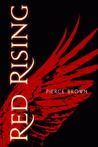
Red Rising (Red Rising Trilogy, #1)Red Rising by Pierce Brown
My rating: 2 of 5 stars

"Man cannot be freed by the same injustice that enslaved it."

The world of Red Rising is one of extreme hierarchy, where humans are color-coded into castes with rigid roles. At the lowest rung of the hierarchy are the Reds, who live, work, and die in the mines of Mars. They're kept in the dark in more ways than one. Sixteen-year-old Darrow expects to live out his life as any other Red, but his wife Eo is driven to "live for more". Eo's actions catapult Darrow into a mission to infiltrate the Golds, the top layer of society's hierarchy, and take down the system from the inside. As his immersion among the Golds progresses, Darrow finds that the world is not as black-and-white as he once thought.

At first, there were a few things that stood out as being promising. In the early chapters, Brown doesn't spoon-feed the reader, and it's sometimes necessary to read between the lines to understand what the characters are doing and feeling. Difficult and important debates arise - especially the question of whether one should engage in action and rebellion (and perhaps martyrdom), or just play along and get by. With a growing sense of unease, the story hurtles towards shocking moments in which his life changes, making it clear that anything could happen. Additionally, the book brings a Roman mythological flavor to interplanetary conquest, which seems like an original and intriguing idea

Unfortunately, once the main story gets going, my interest began to flag, in large part because I was unable to muster any kind of connection or reaction to Darrow. Ostensibly, he's physically and intellectually unprepared for the task ahead of him, but through a combination of perfectly-executed surgery, preternatural good luck, inherent brilliance, and inexplicable charisma, he blends right in as one of the most promising young members of Gold society. He's clearly the Chosen One, and there's never much question over whether he's going to come out on top in the end.

The plot seems to forego the interesting issues that were alluded to early on, and instead becomes a nested doll of recent literary phenomena: the power struggles of Game of Thrones within the teen gladiator scenario of Hunger Games, unfolding in a house-divided school like Harry Potter. (Of these, I only enjoyed Harry Potter, which may explain why the combination of things didn't work for me.) The book eventually acquires the feel of a high-fantasy saga, complete with castles and horses, that just happens to be embellished with futuristic technology. There is a lot happening, but it goes down a convoluted route at a plodding pace, and by the end it was a real effort to keep reading. It might have been easier to stick with if the writing style had been a little more varied or fluid, but it felt like sentence after sentence was written in the same choppy, pedestrian way.

I can see why this book, with all its grit and war strategy, appeals to many people. It just didn't do it for me.

View all my reviews